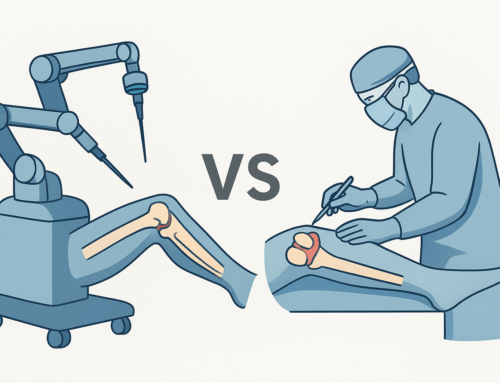
Is Robotic-Assisted Arthroplasty Truly Better? A Look Beyond the Headlines
The real question, however, is whether these systems can translate their technical sophistication into meaningful clinical benefit. It is important to ask: Do patients walk better? Feel better? Experience fewer complications? Or are we mostly witnessing a refined surgical workflow rather than improved outcomes? This piece examines the evidence behind robotic-assisted arthroplasty by taking a closer look at its accuracy, outcomes, cost, and what this shift ultimately means for the next generation of surgeons.
Watching a robotic-assisted total knee arthroplasty in theatre, it was easy to see how three-dimensional planning gave the surgeon more control. This outlines the clearest strength of robotic systems: their ability to enhance the accuracy of implant positioning. Several studies have consistently shown that the use of robotic platforms reduces alignment “outliers” (1,2), particularly in total knee arthroplasty (TKA). This aligns with findings by Song et al., who showed that robotic-assisted TKA resulted in significantly fewer alignment outliers greater than 3° compared with conventional techniques (3). A recent 2024 meta-analysis by Alrajeb et al. demonstrated that robotic-assisted TKA achieved significantly better postoperative mechanical alignment compared to conventional TKA, with an odds ratio of -0.95 (95% CI –1.49 to –0.41, p = 0.0006) (4). Similar results were reported by Kayani et al., who observed improved tibial and femoral alignment and more reproducible bone resections when using robotic guidance (2).
It feels surreal to say that we now live in a world where robotic-assisted surgeries are no longer a futuristic concept, but a common talking point in operating theatres, including orthopaedic ORs. This rapid shift, accompanied by claims of millimetre-level precision, personalised implant positioning and improved soft-tissue balancing, is often portrayed as the natural evolution of joint replacement surgery. But as someone who is extremely enthusiastic about orthopaedics, I have noticed that this discussion is sometimes carried by a sense of inevitability, almost as if robotic surgery is guaranteed to outperform traditional methods simply because it is innovative.
Soft-tissue balancing is another area where robotics seems to add measurable value. Because these systems combine preoperative 3D planning with real-time intraoperative feedback, surgeons are allowed the luxury of making millimetre-level adjustments to flexion and extension gaps (5). A 2021 series in Sensors found that robotic-assisted TKA combined with intra-operative load sensors achieved quantitative knee balance throughout the range of motion in 87% of cases, reflecting improved gap symmetry and enhanced stability, an important finding given that instability remains a major cause of revision knee arthroplasty (6).
In terms of postoperative outcomes, a randomised trial by Marchand et al. reported slightly reduced early postoperative pain and improved knee flexion in robotic cases, particularly within the first 6-12 weeks. However, these differences tend to fade by mid-term follow-up, suggesting that while robotics may influence early recovery, they do not appear to confer significant long-term functional benefit (7).
That said, robotics does come with shortcomings. Several studies have noted longer operative times during the early learning curve, which may increase anaesthetic exposure (1,8). Certain systems also require additional pin placement for tracker arrays, introducing a small but real risk of pin-site complications such as infection or fracture (9,10,11). Most importantly, despite improvements in alignment and balancing, the current evidence has not consistently shown superior long-term clinical outcomes, bringing us back to the central question of whether these technical gains truly translate into meaningful patient benefit (12,13,14).
PROM-based outcomes tell a similar story to the modest improvements seen in early pain and function. Meta-analyses consistently report little to no long-term difference in measures such as the Oxford Knee Score or patient satisfaction between robotic-assisted and conventional arthroplasty (15,16). Even when radiographic accuracy is superior, the difference patients feel does not seem as dramatic as the difference on the screen. Several studies in the literature have also confirmed no significant difference in survivorship or revision rates, further reinforcing that precision alone does not guarantee improved patient-reported outcomes (7,13).
The shift towards innovation in arthroplasty also introduces practical considerations, particularly regarding cost and efficiency. Robotic platforms require substantial investment, ongoing maintenance fees, and additional capital costs (17,18). Several economic analyses have suggested that robotics in arthroplasty cannot be financially justified unless it meaningfully reduces revision rates or complications, benefits that have not yet been confirmed by the long-term data currently available (19). From a broader health-system perspective, the question becomes whether these incremental technical advantages are significant enough to justify the financial and logistical demands, especially in settings with limited resources.
As someone aspiring to enter orthopaedic surgery, I find the shift towards robotic surgery both exciting and grounding. Watching these procedures in theatre makes it clear that future surgeons will need to be fluent in both conventional and robotic techniques, comfortable with precision technology, yet still confident in fundamental surgical principles. Robotic arthroplasty offers compelling benefits in planning, alignment and soft-tissue balancing, but the long-term clinical impact remains uncertain. At this stage, what seems clear is that surgeons of the future will need to integrate innovation thoughtfully, making evidence the basis of surgical decisions. As the evidence continues to evolve, the real challenge for the next generation of surgeons lies in deciding when robotic surgery adds genuine value, and when traditional techniques can achieve the same patient-centred outcomes with fewer demands on resources.
References:
- Chin BZ, Tan SHS, Chia SL, Lo NN, Yeo SJ, Chin PL. Robot-assisted versus conventional total and unicompartmental knee arthroplasty: a meta-analysis of radiological and functional outcomes. J Knee Surg. 2021;34(6):648–658. doi:10.1055/s-0040-1701440.
- Kayani B, Konan S, Huq SS, Tahmassebi J, Haddad FS. Robotic-arm-assisted total knee arthroplasty is associated with improved early functional recovery and reduced time to hospital discharge compared with conventional jig-based total knee arthroplasty. Bone Joint J. 2018;100-B(7):930–937.
- Song EK, Seon JK, Yim JH, Netravali NA, Bargar WL. Robotic-assisted TKA reduces postoperative alignment outliers and improves gap balance compared with conventional TKA. Clin Orthop Relat Res. 2013;471(1):118–126.
- Alrajeb R, Alhammoud A, Aljawadi A, et al. Robotic-assisted versus conventional total knee arthroplasty: a systematic review and meta-analysis of randomised controlled trials. Eur J Orthop Surg Traumatol. 2024;34(3):1333–1343.
- Clement ND, Weir D, Deehan D. Robotic-arm assisted total knee arthroplasty: the relationship between bone resection, gap balancing, and resultant implant alignment. Arch Bone Jt Surg. 2023;11(4):278–284.
- Gordon AC, Conditt MA, Verstraete MA. Achieving a balanced knee in robotic TKA. Sensors (Basel). 2021;21(2):535.
- Marchand RC, Sodhi N, Khlopas A, et al. One-year patient outcomes for robotic-arm-assisted versus manual total knee arthroplasty. J Knee Surg. 2019;32(11):1063–1068.
- Ejnisman L, et al. Robot-assisted knee arthroplasty: analysing the learning curve. J Orthop Translat. 2024;38:1–7.
- Kamara E, Berliner ZP, Hepinstall MS, et al. Pin site complications associated with computer-assisted navigation in hip and knee arthroplasty. J Arthroplasty. 2017;32(9):2842–2846.
- Thomas TL, Pivec R, et al. Pin-related complications in computer-navigated and robotic-assisted knee arthroplasty: a systematic review. J Arthroplasty. 2022;37(11):2291–2307.e2.
- Nogalo C, et al. Complications and downsides of robotic total knee arthroplasty: a systematic review. Knee Surg Sports Traumatol Arthrosc. 2023;31(3):736–750.
- Jeon SW, et al. Robotic-assisted total knee arthroplasty does not improve long-term clinical or radiologic outcomes. J Arthroplasty. 2019;34(8):1656–1661.
- Lee YM, et al. No difference in clinical outcomes and survivorship for robotic, navigational, and conventional primary total knee arthroplasty with a minimum follow-up of 10 years. Clin Orthop Surg. 2023;15(1):82–91.
- Yang H-Y, et al. Robotic total knee arthroplasty with cruciate-retaining implant: a 10-year follow-up. Clin Orthop Surg. 2017;9(2):169–176.
- Fu X, et al. Comparison of robotic-assisted and manual total knee arthroplasty: an updated systematic review and meta-analysis. J Robot Surg. 2024.
- Plaskos C, et al. Conventional vs robotic/computer-assisted total knee arthroplasty: a meta-analysis. Orthop Rev (Pavia). 2021;13(3):21225.
- Fang CJ, et al. Total knee arthroplasty hospital costs by time-driven activity-based costing: robotic vs conventional. Arthroplast Today. 2022;13:43–47.
- Cotter EJ, et al. Comparative cost analysis of robotic-assisted and manual primary total knee arthroplasty. J Knee Surg. 2022;35(2):176–184.
- Vermue H, et al. Robot-assisted total knee arthroplasty cost-effectiveness analysis: a Markov decision model. J Robot Surg. 2025.